


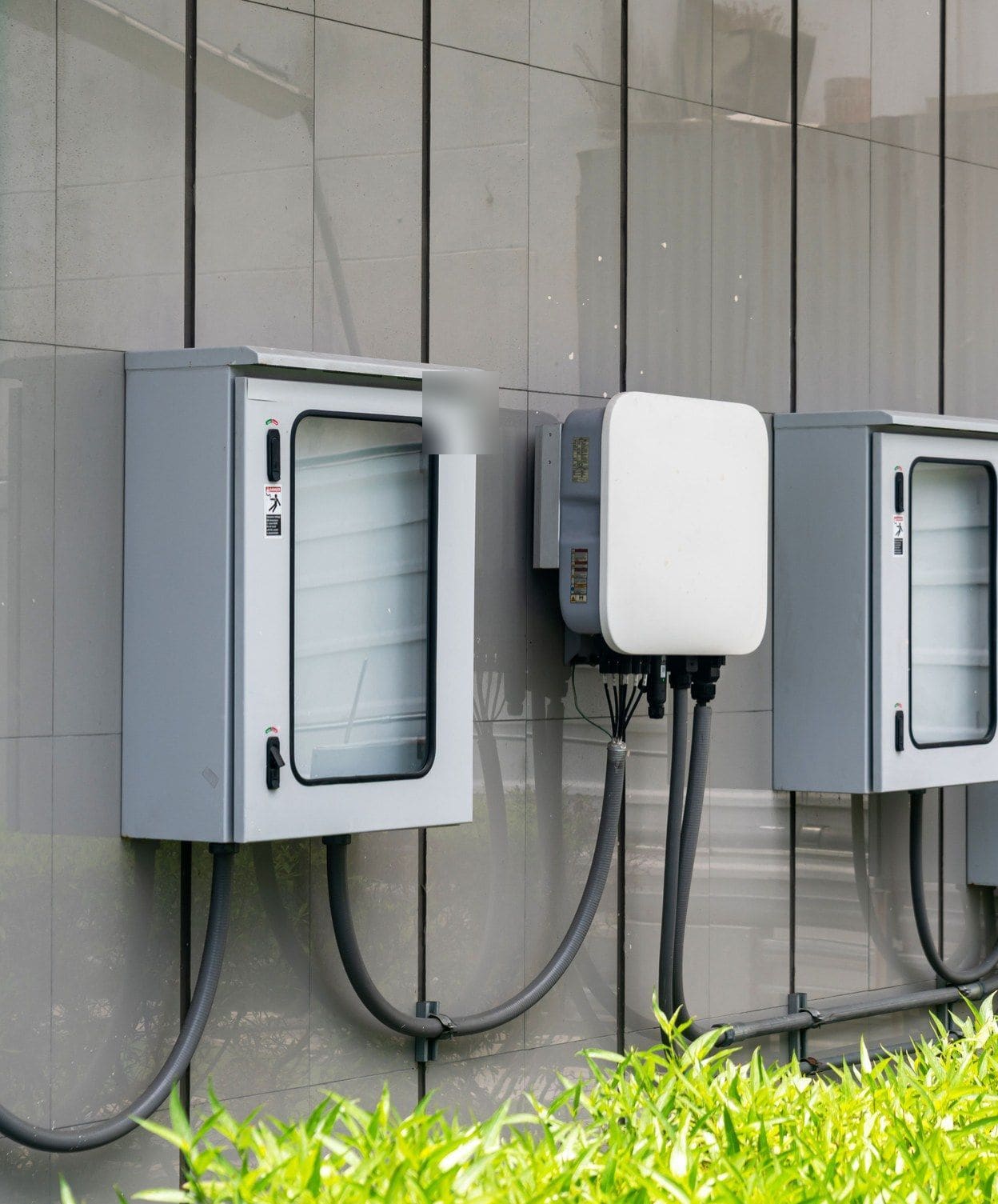
Solar inverters
An inverter sized to your array, never oversold.
Which kind you need depends on how simple your roof is, and whether a battery is likely.
- On the example
- 6.2 kWp array
- Simple roof
- String inverter
- Shade or several faces
- Per-panel control
What it does
Direct current in, alternating current out.
Direct current flows one way. The alternating current in your sockets, and on the grid, changes direction many times a second. The inverter converts the panels’ power from one to the other.
It also keeps adjusting as the light changes, finding the point at which the panels give their most, from first light to dusk.
Three ways to convert
One inverter where the roof is simple, more control where it isn’t.
All three do the same job. What changes is where the power is managed, and so how much one shaded panel costs the rest.
One string inverter
- Best where
- The roof is simple: one clear face, or two with a string each, and little shade through the day.
- Watch for
- Shade, because panels on one string share a current and a shadow on one holds back the others.
Optimisers
- Best where
- Shade falls on part of the array, since a small box behind each panel keeps it working at its best on a shared inverter.
- Watch for
- More electronics on the roof, each one a part that may need a scaffold to reach if it fails.
Micro-inverters
- Best where
- The roof has several faces or scattered shade, since every panel converts its own power.
- Watch for
- The same trade-off on the roof, and a cost that grows with every panel added.
The assembly · 01–05
Every part sized before anyone climbs a ladder.
Pitch, area and shading read from aerial imagery — before a survey is booked.
6.2 kWp drawn onto the example roof, about 5,400 kWh a year.
One inverter, sized to the string. Never oversold.
10 kWh for +£4,500, or none at all. We price both.
One gold run, panels to meter. The installer we chose signs it off.
Hybrid inverters
If a battery is likely, the inverter is chosen with it in mind.
A hybrid inverter runs the panels and a battery from one box. Spare power from the roof charges the battery as direct current, and is converted once, on its way to the house in the evening.
With a standard inverter, a battery can still be added later with its own inverter beside it. Neither route is wrong. Telling us now can change the inverter we choose and leave room for what comes next.
Size, grid and wall
Rated, notified and sited.
- 01
Matched to the array
An inverter is rated for how much it can convert at once. Panels seldom reach their full rating on a UK roof, so an inverter a little under the array’s size is often a sound match. One well over it costs more and makes nothing extra.
- 02
Told to the grid
The inverter’s size also shapes what your DNO, the company that runs the local grid, is told. Small systems are usually notified after connection; larger ones need approval first. We chase until it’s done.
- 03
A wall to live on
Usually in a garage, a utility room or the loft. It needs air around it, because it warms as it works, and space to be reached. The surveyor looks for the right wall.
On the quote
What the installer’s quote should specify.
We check every line of the quote before it reaches you. These are the ones that should never be missing.
- The make and model of the inverter
- Its rating, beside the array size
- Whether it is a hybrid, ready for a battery
- Any optimisers or micro-inverters, and how many
- Where it will be mounted
- The manufacturer’s warranty on the inverter
Manufacturers we see on quotes
- SolarEdge
- Enphase
- Sunsynk
- Fox ESS
Named because they turn up on quotes. We sell none of them.
Inverters · questions
Asked about inverters.
01Do I need optimisers or micro-inverters?
Only if shade or the shape of the roof calls for them. On a simple, clear roof, a string inverter does the job, and we won’t add parts the roof doesn’t need.
02Does the inverter need looking after?
Very little. Keep the space around it clear so it stays cool. If it shows a fault, call us first: we know who fitted it and who to chase.
03Will the inverter need replacing before the panels?
It may. An inverter usually has a shorter working life than the panels it serves, which is why its warranty is worth reading on the quote.
Keep reading
The rest of the system.
-
Solar panels
The panel that suits your roof
-
Home batteries
Matched to your evenings
-
Survey day
Roof, loft and meter, checked on site

Estimate or survey
Start with a postcode.
Our estimate is free. If you proceed to survey, our partner installer invoices you directly; we receive a referral fee from them, never from you, and it never affects which installer we introduce.
We use these details only to send your estimate and arrange a survey. Privacy Policy
This form needs JavaScript switched on.
Or ring us free on 0800 593 0413