


Battery · 5 min read
Battery or no battery: reading your own bill
Where your units go by the hour, how tariffs and export rates change the sums, and one roof priced with and without a battery.
Read the guide
Battery storage
We price every estimate with a battery and without one, so you can see what it adds to the price, what it adds to the saving and how long each takes to pay back.
How it works
Whatever is running in the house takes the roof’s power first. Around midday a roof often makes more than the house is using, and without a battery the rest is exported to the grid. A battery catches that spare power instead, and the house draws on it after dark, when it would otherwise be buying from the grid.
Whether that pays comes down to the gap between two prices: what you pay for a unit and what you are paid to export one. The example estimate assumes 30p bought and 16p exported. Every unit stored and used at home instead of exported is worth roughly the difference. Tariffs and export rates vary by supplier, so yours may differ.
How export payments work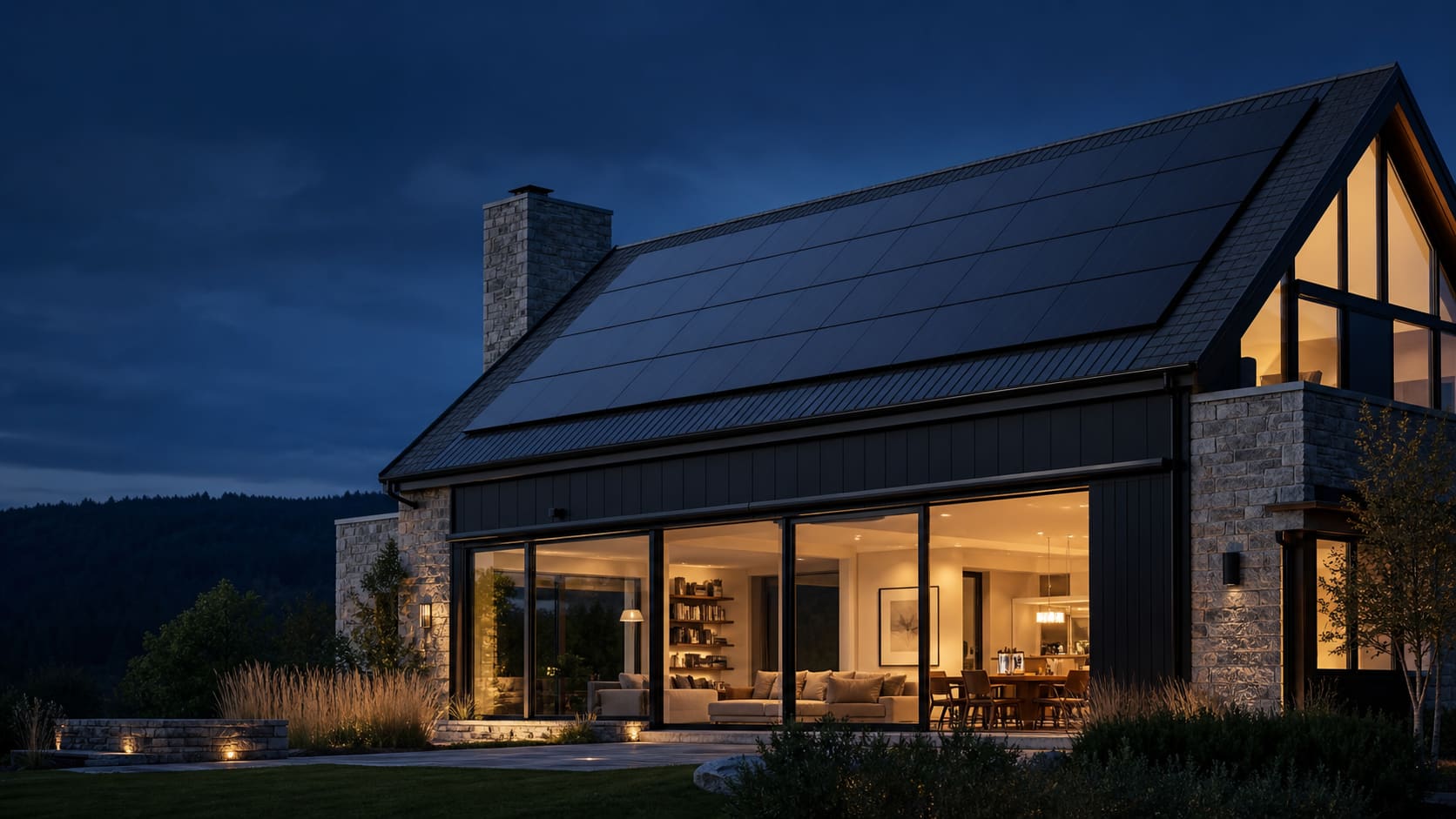
Battery storage
Panels make most at midday. Most homes use most in the evening. A battery moves one to the other, and whether that pays depends on when you are home, what you pay per unit and what you are paid for export.
On your estimate, 10 kWh adds £4,500, and we show the payback both ways. The choice stays yours.
See both on your estimateBoth ways
On the example roof in Exeter (EX4), a 6.2 kWp array costs £7,200–£8,900 installed without a battery and £11,700–£13,400 with a 10 kWh one. At a £1,500 yearly bill, the home uses 28 per cent of what the roof makes without the battery, and 48 per cent with it.
That changes where the saving comes from. Without the battery it is about £460 off the bill and £620 exported, about £1,080 a year, paid back in about seven years. With it, about £780 off the bill and £450 exported, about £1,230 a year, paid back in about ten. The battery’s own share is about £150 a year for £4,500, so on its own it would take about 30 years to repay. Both sit side by side on your estimate.
Battery or no battery: the sumsChoosing one
Capacity matched to your evening use, not the biggest box on the list.
Sized to what you use after dark. Too big and it sits partly empty; too small and spare midday power still goes to the grid.
A garage, a utility room or an outside wall. The surveyor looks for the spot while they are there.
With and without, side by side, on the same estimate. On the example estimate, 10 kWh adds £4,500.
Tesla Powerwall, Sigenergy, Fox ESS and Sunsynk, for example. We weigh them on how well they match your evenings.
Battery storage · questions
Yes. Power stored in the battery is used at home instead of exported. On the example estimate, export income falls from about £620 to about £450 a year, while the saving off the bill rises from about £460 to about £780.
Yes, and it’s worth telling us now. Planning for one can change the inverter we choose and leave room for it.
It can. Prices on a time-of-use tariff change through the day, usually cheapest overnight, and a battery is more often worth it on one.
No. We price the system with a battery and without, show the payback of each and leave the decision with you.
A ten-year manufacturer’s warranty, with a share of their capacity guaranteed to the end of it. The manufacturer’s own terms say how large that share is.
From the guides
Every guide explains one part of the job in plain English.
Battery · 5 min read
Where your units go by the hour, how tariffs and export rates change the sums, and one roof priced with and without a battery.
Read the guide
Money · 5 min read
How the Smart Export Guarantee works, what has to be in place before payments start, and why part of a solar saving is export income.
Read the guide
Planning ahead · 5 min read
Why an electric car or a heat pump changes the array, the inverter and the battery, and how to plan for both before you buy solar.
Read the guideKeep reading
Your roof sized and priced from above
Planned into the array
Covered in layers, chased to sign-off

Estimate or survey
Our estimate is free. If you proceed to survey, our partner installer invoices you directly; we receive a referral fee from them, never from you, and it never affects which installer we introduce.
We use these details only to send your estimate and arrange a survey. Privacy Policy
This form needs JavaScript switched on.
Or ring us free on 0800 593 0413