


Most UK homes end up with somewhere between eight and fourteen panels. The honest answer for your house depends on three things: how much electricity you use, how many panels your roof can carry, and the limit your grid connection puts on the inverter. On the example estimate, a semi-detached house in Exeter, the roof carries 14 × 445 W panels, 6.2 kWp in all, making about 5,400 kWh a year. This guide shows how that number is reached, so you can see roughly where yours will land before anyone visits.
Start with how much electricity you use
The first number is on your bill: the units, in kWh, the house used over the last year. If the bill only shows a monthly figure, twelve of them is close enough.
Ofgem publishes typical values for a UK household, and revised them downwards from 1 July 2026. A low user is now put at 1,600 kWh a year, a medium user at 2,500 kWh and a high user at 3,800 kWh. Most three-bedroom homes without an electric car or a heat pump sit around the middle figure. A home with either sits well above the top one, which is why the estimate asks about them.
Your bill decides two things at once. It sets the size of system worth having, and it sets how much of what the roof makes you will actually use yourself rather than export. Both matter more than the panel count on its own.
What one panel makes in a year
A panel’s label gives its peak output in watts. The panels on our example estimate are 445 W each, which is typical of what installers fit in 2026. The label is not what the panel makes: the sun is not at peak for long in Britain, and the year has winters in it.
What a panel actually produces depends mostly on where it is and which way it faces. The European Commission’s PVGIS model, which installers use for the same job, gives these yields for a south-facing roof at a 35° pitch, after typical system losses:
- Exeter: about 1,050 kWh a year for every kWp installed.
- Bristol: about 1,020 kWh per kWp.
- London: about 1,020 kWh per kWp.
- Manchester: about 890 kWh per kWp.
So one 445 W panel on a good roof makes roughly 390 to 470 kWh a year, depending on where in England it sits. An east- or west-facing roof makes less, a shaded roof less again, and a roof in Scotland less than one in Devon. On the example roof, 14 × 445 W panels make about 5,400 kWh a year, which is 6.2 kWp multiplied by the Exeter yield.
The arithmetic, on paper
Divide your yearly use by what one panel makes, and you have the number of panels that would cover it on paper:
- A low user at 1,600 kWh needs about four panels to match their yearly use.
- A medium user at 2,500 kWh needs about six.
- A high user at 3,800 kWh needs eight to ten.
- Add an electric car doing 10,000 miles a year, at roughly three and a half miles per kWh, and that is close to another 3,000 kWh, or another six to eight panels.
- A heat pump can add as much again as the rest of the house uses, so the system that suits a heat-pump home is often twice the size.
That arithmetic is where most online calculators stop, and it is the wrong place to stop, for a reason the next section explains.
Why matching your yearly use is not the aim
A roof makes most of its power in the middle of a summer day. A house uses most of its power in the evening and in winter. Matching the two totals over a year does not mean the house runs on its own power; it means a lot of summer electricity goes to the grid while winter electricity is bought in.
The gap in value is large. The estimate assumes you pay 30p for every unit you buy and are paid 16p for every unit you export. A unit you use yourself is worth almost twice a unit you sell. So the system that pays back fastest is usually the one sized to what the house uses while the sun is up, plus whatever a battery can carry into the evening, rather than the one that covers the whole year’s total.
That is why two homes with the same bill can be given different panel counts. One is empty all day and has no battery; the other has someone home, a car on the drive and a battery in the garage. The second can use far more of what a bigger roof makes.
How many panels fit on the roof
The second limit is physical. A modern panel covers a little under two square metres. The usable area of a roof is what is left after the ridge, the hips and edges, a safe margin for the fixings and anything already sitting there: roof lights, vents, a flue, the aerial. On the example house that leaves about 28 m², which is where 14 × 445 W panels comes from.
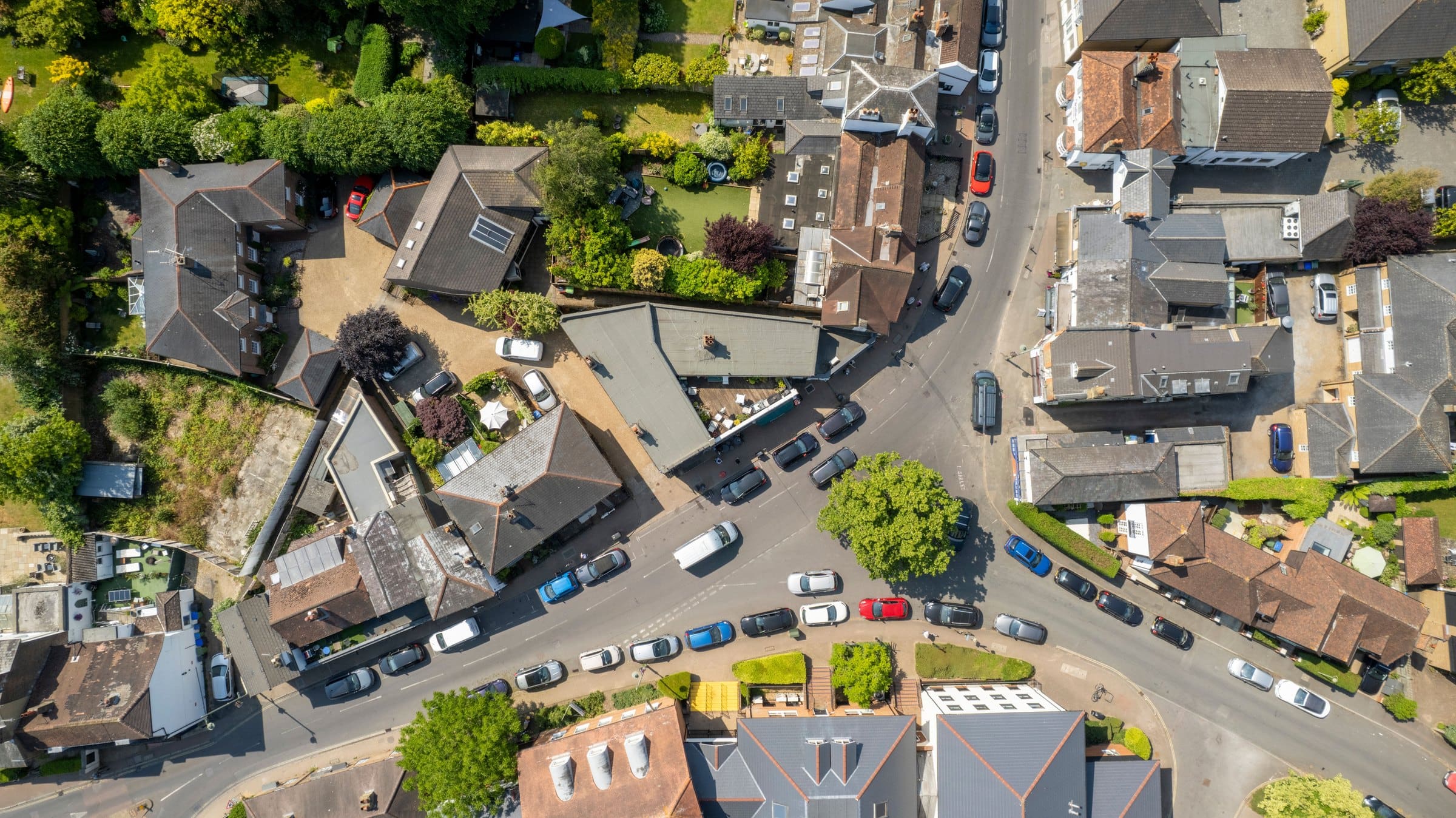
Reading the roof from above gives us that area before anyone climbs a ladder, and it often settles the question on its own. A terraced house with a single south-facing slope may carry eight panels and no more. A detached house with two clear slopes may carry twenty. If the roof can’t carry the number your bill suggests, the roof wins, and the estimate says so.
The grid limit on the inverter
The third limit sits in the fuse box rather than on the roof. In Great Britain an inverter rated at up to 3.68 kW per phase can be connected and the network operator told afterwards, under a process called G98. Anything larger needs the network operator’s permission first, under G99, which your installer applies for before the work starts. Most homes have a single phase, so that is the line that matters.
The limit is on the inverter’s output, not on the panel count. Arrays are often a little larger than the inverter that serves them, because panels rarely hit their peak together, so a 6.2 kWp array can sit behind a smaller inverter without wasting much. Where the right system for the house is clearly bigger than the G98 line, the G99 application is a normal part of the job, and the estimate allows time for it rather than shrinking the array to dodge it.
When fewer panels is the right answer
Sometimes the honest number is small, or zero. A roof that faces north and nothing else will not pay back in a reasonable time. A roof in heavy shade from a tall neighbour or a mature tree can lose more than half its output, and optimisers only recover part of that. A home that will be sold within a few years may not see the payback at all. And a very low bill, in a house empty all day, leaves little for the roof to offset.
In each of those cases the estimate will tell you so. We don’t install, so the number of panels we size is the number that suits the house, not the number that fills a van.
The right system is the one sized to the house, not the one that fills the roof.
Where the battery, the car and the heat pump come in
If a car or a heat pump is coming in the next few years, say so at the estimate stage. It changes the array, often the inverter, and sometimes the case for a battery. Planning for them now is far cheaper than adding panels later, when the scaffold has gone and the inverter is already at its limit. The guide on solar with a car or heat pump works through it, and battery or no battery covers what a battery does to the sums.
What we do
Give us a postcode and your yearly bill, and we read the roof from above, size the array to the house and the grid connection, and price it with and without a battery. You see the panel count, the system size and what it should make before anyone visits. If the roof can’t carry what the bill suggests, or the sums don’t work, the estimate says so plainly.